

Open spandrels.
Next week: Imogen Binnie talks Nevada with Being Alive Book Club
I spent every morning last week making coffee staring at this bridge that connects the Virginia side of the Potomac (Rosslyn on the left) to the District side (Georgetown on the right.)
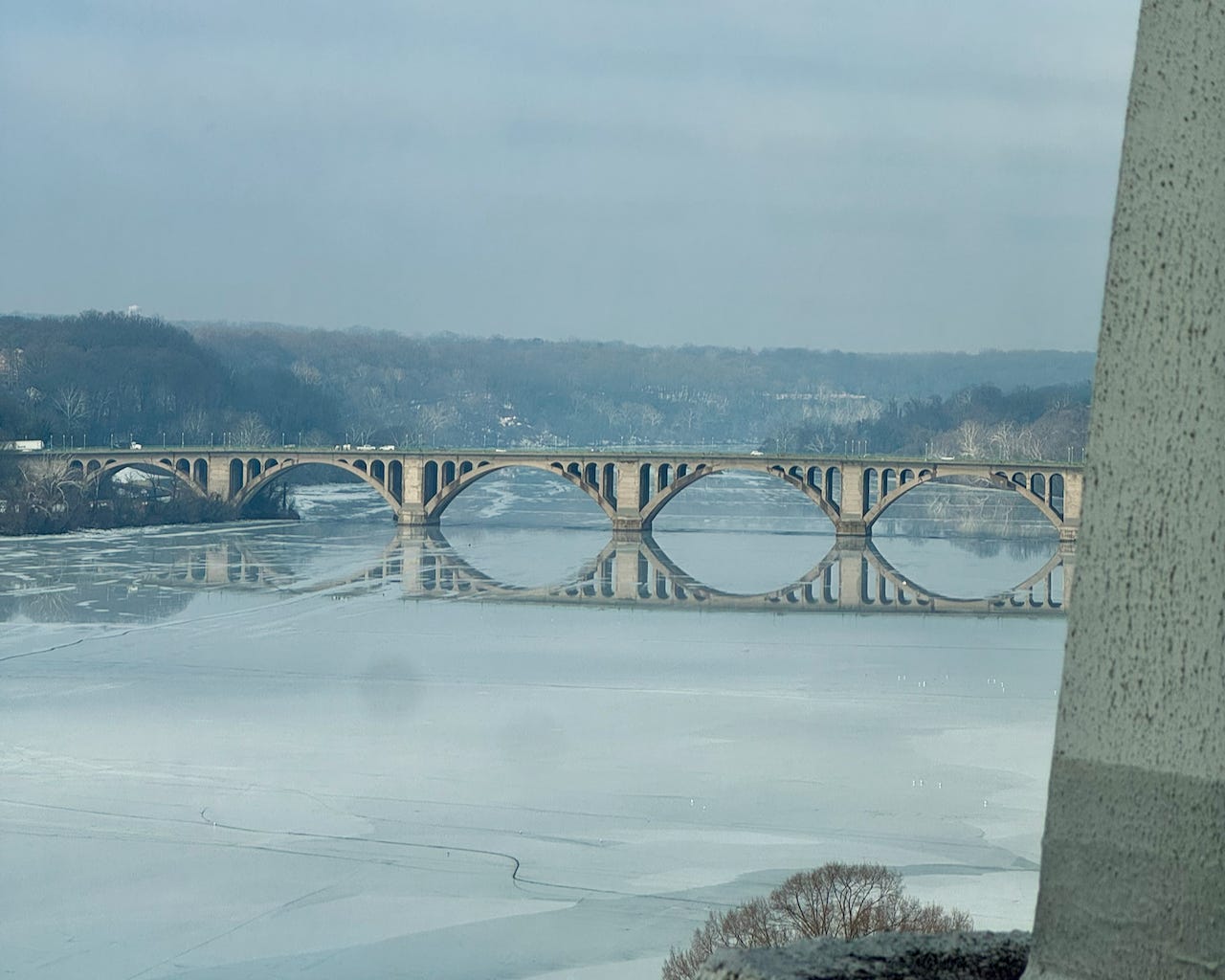
It’s not a bad view, but everything is contextual. The sky was always gray. The river always frozen over. The vibe was heavy. The air freezing. There someone beloved was dying nearby in the hospital and there was nothing any one of us could do but let it unfold. To witness the crossing over.
Michael died peacefully, on his birthday, with his husband, my stepfather, by his side. That morning before I went to the hospital I drew the flowers I bought for him. For both of them. For all of us. Because that was something I could do.
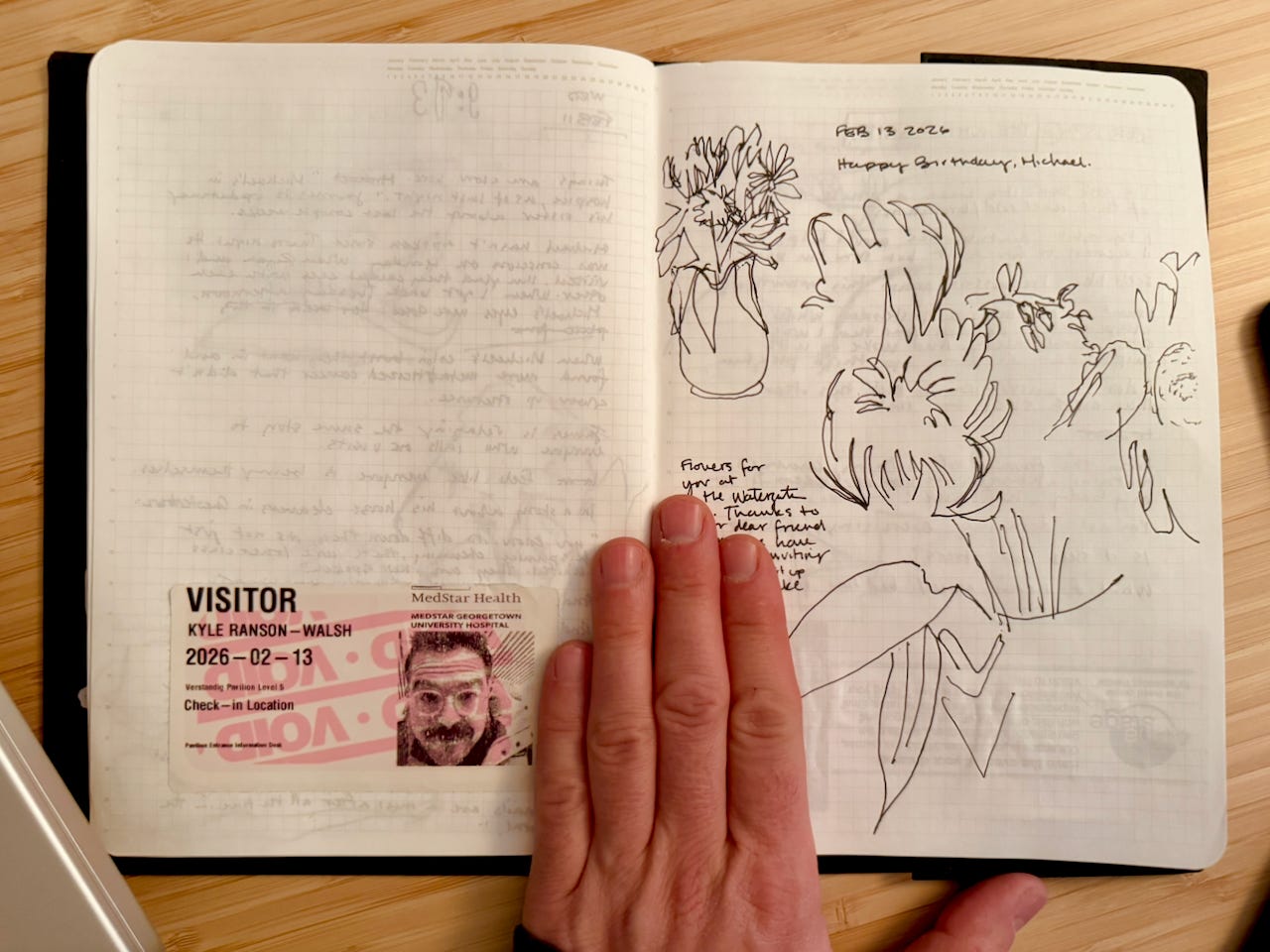
Two mornings later, mourning, staring at the bridge I crossed more than 100x as a child, I took out my sketchbook and drew. I scribbled arches impatiently, got the proportions all wrong, moved on to the planes headed towards DCA, and then to the inconsequential Arlington skyline.
On the sixth morning of bridge staring, more rested, I grabbed my sketchbook and took a seat. I slowed down my breathing, sharpened my looking. I hadn’t noticed the bridge’s reflection before. And what is going on with those arches exactly? I started researching.
(Francis Scott) Key Bridge was conceived in 1916, though in typical Washington fashion, it took many years and a few dramatic Congressional appropriations negotiations to complete. The new bridge finally opened in January 1923.
The bridge was constructed in collaboration with the Army Corps of Engineers and the US Commission of Fine Arts employing the relatively new technology of reinforced concrete and steel. To lighten the load of each concrete span, the designers punched out additional arches creating its iconic, elegant “open-spandrel” structure.
What is an open spandrel? And before we get to that, what’s a spandrel? I wondered, too.
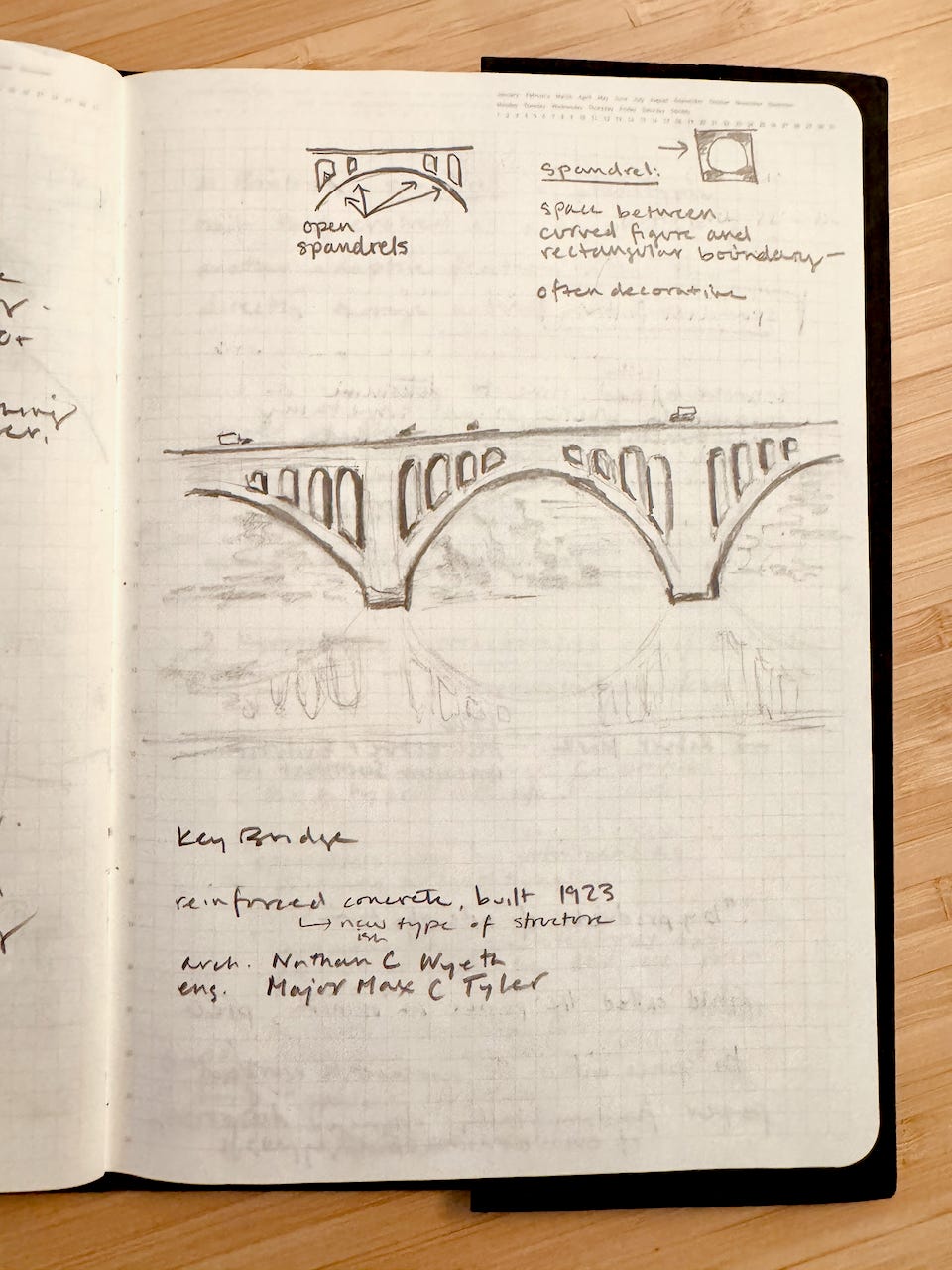
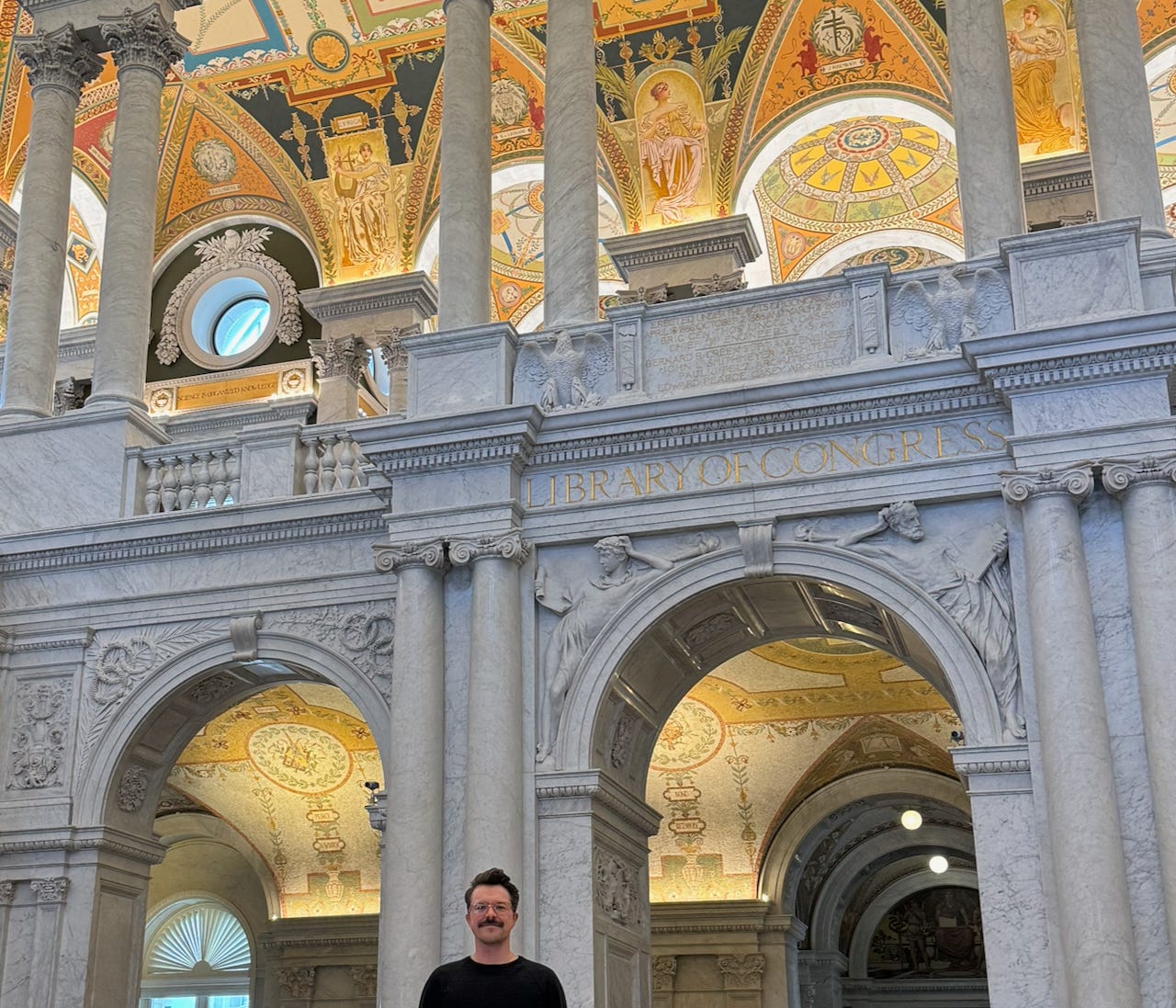
In architecture, a spandrel is the space between a curved figure and a rectangular boundary—the gap between something (an opening) and the surrounding structure. When designing and confronted with the inadvertent, one has the obvious option to leave it unadorned. Or, lean in and make a dramatic moment out of the whole situation. This is the Library of Congress’ approach.
In 1979, paleontologist Stephen Jay Gould and geneticist Richard Lewontin employed this architectural metaphor to argue in a groundbreaking paper that not all biological traits evolve directly from natural selection, some are what we might call happy accidents. What happens because something else happens. Music is a classic example, something so fundamental to the human cultural experience which exceeds evolutionary explanation. Gould and Lewontin named these nonadaptive byproducts spandrels.
That bridge staring back at me was in fact a key—last week, our family, a beautiful spandrel.
xx Kyle

▶️ Press Play
It’s been a heavy time, take a break and watch these queer Icebreakers carve some space on the ice. Co-directors Marlo Poras and Jocelyn Glatzer’s short doc weaves together gorgeous contemporary shots and riveting archival footage.
I grew up watching my brother dance. Watching Joel Dear skate reminds me of how my brother used to move. The resemblance is so uncanny that within seconds my daughter asked, “Is that Uncle B?”
For a sport that revolves around expressiveness, romance and a hell of a lot of sequins, the world of figure skating has a startlingly archaic stance on sexuality and gender. Same-sex pairs and gender bending are strictly forbidden in elite, international competitions – but once every four years, a parallel skating universe appears. At the Gay Games, an intergenerational group of skaters pushes the boundaries of their sport in the hope that mainstream skating will one day encompass a richer spectrum of the human experience.
🔗 Follow the Reader
I still pay to have someone deliver me the NY Times on the weekends even though unwrapping it doesn’t feel as good as it used to. During a recent recycling purge I dug up an entire section devoted to the state-by-state impact of “Remaking America.” Bittersweet to see the paper featuring a trans military officer losing benefits (Hawaii) and a trans teenager at risk of losing hormones (Colorado.)
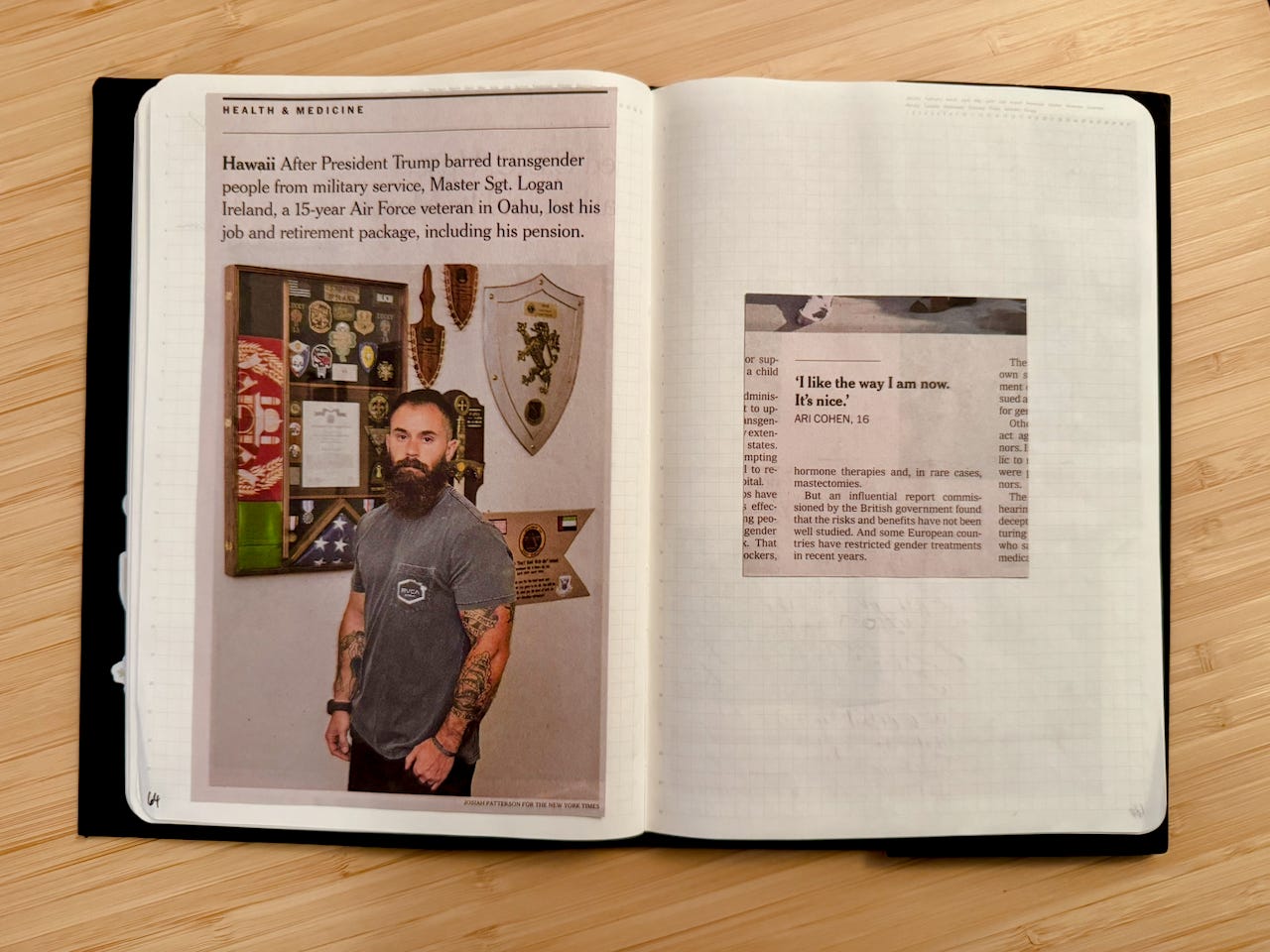
Master Sgt. Logan Ireland (above) was the named plaintiff in Ireland v Hegeth, now covered by Talbott v USA, which challenges the administration’s executive order banning openly transgender people from serving. He is also one of the service members featured in the award-winning 2018 documentary TransMilitary. Highly recommend and free to stream on YouTube.
📚️🏳️⚧️✨ Being Alive Book Club
This month we’re riding along with Imogen Binnie to Nevada— a novel with psychological urgency and a cult following that's only grown since it was first published in 2013.
Join us on Zoom Wed Feb 25th at 8p ET 5p PT (RSVP for Imogen)

Being Alive Book Club is a community effort to amplify trans voices by reading trans authors. Every month we read a book across genres.
February: Nevada with Imogen Binnie
March: Pretty with KB Brookins
April: Night Night Fawn with Jordy Rosenberg
May: When the Harvest Comes with Denne Michele Norris
June: Woodworking with Emily St. James
Have a trans author you want to recommend to Being Alive Book Club? Drop me message or comment on this post.